
Sitting in the waiting room of our local mechanic, I turned to the apple-cheeked, soft white curled woman sitting next to me.
Let’s see what the Universe wants to tell me about this feeling.
“Can I share something with you?”
“Of course, my dear.”
“My daughter is turning 10 today.” Tears flooded my eyes. “It makes me happy sad.”

I think I want to write a poem about this plant and how wonderful it was to find it.
“I love this plant right now,” I shared with the Bean.
Before I could finish my thought aloud, the Bean jumped in, “Well, I guess you should marry it then!”

Dearest Beloveds,
Parenthood can be quite humbling.*
One of the most confronting parts of being a parent is realizing you are passing down your neuroses/limitations/Cranky Monster baggage to your children.
Many teachers over many years have all taught me the same thing. We are energetic beings in physical bodies. Our energy body/aura surrounds us like a glowing multidimensional egg of vibrational me-ness.
In that aura there can be blockages. Blockages made of past habits, memories, things that trigger us, woundings, fears, etc etc. Rob Wergin likes to call them mud pies. Mucky, dark, heavy glurpy goo that sticks within our aura and blocks energy flow. Meme told me when I was 12 that 4th dimensional creatures live in our auras - called in as helpers when we are afraid or in pain but then they never leave and become a handicap.* Perhaps those two are the same thing.
I spend a great deal of energy and attention cleaning up my personal mudpies - but sometimes I think I splash mud onto you two when I am not thinking.

“Four” Dragon stated.
“Yea, I keep stopping, I don’t know why.” Bean retorted.
“You jumped, but it got caught on the back of your leg… Wait, would you stop? I want to go and grab mine.” Dragon moved towards the stairs.
“Yours is the green one.” Bean called out. “It is like neon green, Dragon.”
“Dragon, I just did five… I almost did six!”
“Hold on Bean, wait till I come back up!”
We purchased the jump ropes in March of 2020.

Dearest Beloveds,
I switch hats throughout the day from Adulting Corinna to Parenting Corinna and vis-a-versa. Adulting Corinna pays attention and gives time to MY wants, desires, thoughts, responsibilities, and curiosities.
Parenting Corinna pays attention and gives time to YOUR wants, desires, thoughts, responsibilities, and curiosities.
I have found during my almost 10 years as a hat switcher, that life goes more smoothly when I wear only one hat when I am with you two - because, as you may have noticed, your mother only has one head.

One of the things I adore about meditation retreats are the blunt conversations one has with strangers. For a stint of a weekend/five days/two weeks a group of strangers are thrown together without any historical baggage or expectations of future interactions. It lends itself to very honest conversations.
Like the one I had at the end of our stint in India for the 10,000 Course for World Peace. We were checking in to the hotel in anticipation for our 4 am departure the next morning back our own beds.
“Are you insane? Why did you bring your kids?” Identical badges hung around our necks.

It has been many many moons since I posted a recipe.* However, times change.
The juggle of the school bus, after school activities, and my inner push to not feed by children denatured oatmeal in the form of cereal for breakfast or cheesy bread/pasta every night means that I have had to focus time and energy on weekend feasts that turn into leftovers (frozen or otherwise) during the week.**
One of my favorite breakfasts, snacks, and or desserts is banana bread. It took me a while to land on a recipe that is both sugar free and gluten free - but this one really works.

One of the fun things about being an adult - I am “allowed” to write on my bedroom walls. Wall decor is entirely my choice. And any costs associated with repair, repainting, etc are for me to bear.
Last fall I was repeating to myself over and over certain prayers from Rob Wergin. So much so, I decided to record then on my bedroom walls.
The aim was to have a constant drip of attention/awareness on those thoughts.
Dearest Beloveds,
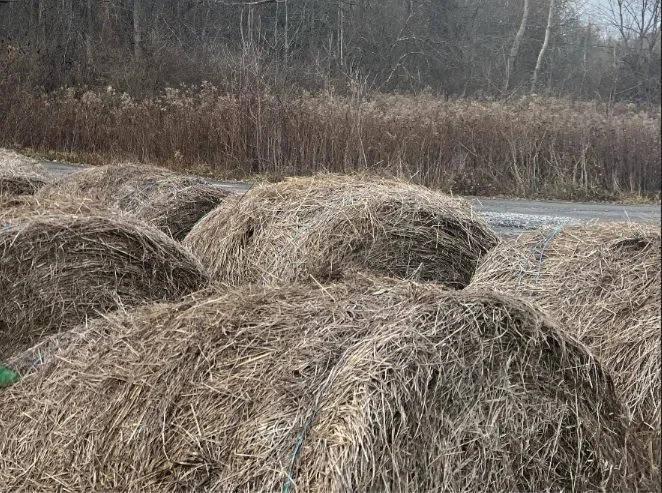
Recently Dragon and I were driving along some country road and admiring a surfeit of round hay bales. Many acres of fields were shorn yet all of the bales were concentrated on one field.
“Momma! Look how close those hay bales are! If they were closer I could jump between them.”
“Yes, you certainly could, that is very true. Would you take a running leap or try to bounce like a bunny?”
“Bounce like a bunny.”


I write that blithely, as if I am drinking plant medicine daily. Not true. But the sentiment holds. (and I like the sentence.)
When I embark upon an evening of ayahuasca, my routine is this. I hold the medicine in my hands and say a prayer.
LET’S DO THIS THING! Thank you for whatever is about to come. I am so grateful.